


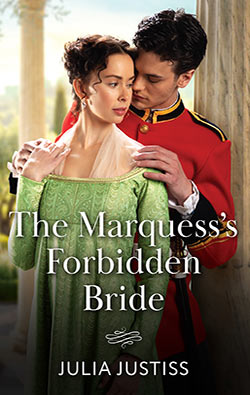
The Marquess's Forbidden Bride
September 29, 2026
A forbidden love 1830s romance
Secret courtship…
With the enemy!
Lieutenant Charles Marsden returns from war and inherits the title of Marquess from a father he never knew! Unsettled by his new status, he’s more grateful than ever for the guidance of well-connected debutante Miss Emma Wellingford, even if their families are enemies…
Craving independence over marriage, Emma agreed to a pact with Charles—fend off each other’s unwanted suitors. But Emma struggles as the arrangement brings them closer than is proper, for Charles is now the kind of titled gentleman she swore never to marry. Forced to hide their courtship from their feuding families, their bond feels even more forbidden…
London, May 1816
CHAPTER ONE
‘A pleasure to meet you, Miss Wellingford. That’s the loveliest smile I’ve seen in London,’ Lieutenant Charles Marsden said, gazing down at the young lady to whom he’d just been presented in Stanhope House’s elegant drawing room.
Charles’s colonel looked over from where he’d been chatting with the Marquess of Englemere, their host and the colonel’s good friend. ‘Be on your guard, Miss Emma!’ Colonel Wexford said. ‘This one can charm the birds from the trees.’
‘Or ladies from their virtue?’ Miss Wellingford murmured, her voice pitched so low that Charles only just caught the comment.
Not quite so unworldly an innocent, despite having been introduced as a maiden in her first Season, Charles thought. ‘Colonel, you wrong me!’ he protested. ‘You’ll give Miss Wellingford an entirely inaccurate picture of my character.’
‘I’m sure you are quite charming, Lieutenant,’ the lady replied, a certain…wariness in her tone.
The lady appeared suspicious of compliments, Charles thought, but the unexpected reserve only added to her attractive appearance and piqued his interest.
‘He is charming,’ Colonel Wexford confirmed. ‘But the lieutenant’s right. I shouldn’t give you an erroneous impression of his character,’ he continued. ‘He might have cut a swath through the ladies in Lisbon, but Marsden is a true gentleman and like us, Englemere, a fellow Oxford man. He’s been an exceptional officer that I count myself privileged to have under my command, else I wouldn’t have presumed to recommend him to you or introduce him to your wife and her lovely sister.’
‘We are pleased you did,’ Lady Englemere said, smiling at Charles. ‘What a relief, after the shock of having Napoleon escape from Elba, bringing us to the brink of all-out war again, to have that finally settled at last. We can only be grateful to the soldiers who fought so valiantly to make that happen.’
‘Lieutenant Marsden is certainly one of them,’ the colonel said. ‘He’s been in the thick of the action from the grim days of the retreat from Corunna in ’09 all the way through Waterloo and the occupation afterwards. His unit of Dunbar’s Dragoons has only just returned from Paris.’
‘Now that they have, and God willing, the army is through with battles at last, Wexford tells me you are looking for some other occupation,’ Lord Englemere said.
‘All England must be grateful for your service,’ Lady Englemere said. ‘We’d like to do whatever we can to assist you.’
‘Being an active sort, Marsden isn’t interested in remaining in a peacetime army,’ Colonel Wexford explained. ‘Which is why I thought of you, Englemere. I’ve been away from England so long, I don’t know who might need an enterprising young man of wide experience to act as a secretary or assistant. With your contacts in Parliament and Society, you might have a better idea.’
‘You’d be interested in such a post?’ the marquess asked Charles.
‘In the short term,’ Charles confirmed. ‘My adoptive father owns a prosperous estate in Norfolk, but he’s in robust health and the property isn’t large enough to need two managers. With me away, first at university and then with the army, he’s accustomed to handling things on his own. Since I doubt I’ll be needed to take over anytime soon, in the interim, I’d like to do something…useful. As the colonel says, after having been occupied in a vital endeavour for so many years, the idea of simply…drifting about London doesn’t appeal.’
Miss Wellingford, who’d been silently following the conversation, nodded approvingly. ‘No one would think the worse of you, after all your years at war, were you to simply enjoy the peace you helped win.’
‘True, battles were fierce and conditions on campaign could be difficult and uncomfortable…’ he began, his smile fading as memories of the horrors of Badajoz and Waterloo flashed through his brain. But ladies don’t need to hear about that.
Retrieving a smile, he continued, ‘Much as I’d like such a charming lady to envision me a hero, I must confess that life in the army wasn’t all toil and sacrifice, Miss Wellingford. Battle campaigns involved long periods of inaction where one was able to enjoy life. Even for mere lieutenants, winter cantonment in Lisbon offered dinners, balls, the theatre and a variety of entertainments. When in the field, we enjoyed hunting, fishing, card parties, even amateur theatricals.’
‘A rich and varied life, then?’ Lady Englemere said.
‘It was,’ Charles confirmed. ‘Which is not to say that war isn’t a grim business, but there is much about the army I will miss. Knowing one was doing something important. The satisfaction of leading valiant men and seeing to their welfare. Measuring up to demanding tasks. And of course, the camaraderie one develops with fellow soldiers.’
‘Indeed,’ Colonel Wexford confirmed. ‘Nothing like fighting for one’s life in a pitched battle to form friendships that last a lifetime! Save for my bond with Englemere, which goes back to our days at Eton, my best and closest friends were made in the army.’
At that moment, the butler appeared at the door. ‘Dinner is ready, Lady Englemere.’
‘Shall we go in?’ the marchioness said, rising. ‘Colonel, you’ll give me your arm? And Lieutenant Marsden, would you escort my sister?’
Wondering how the wary lady would take that instruction, Charles said, ‘I’d be delighted.’
Smiling, he offered her his arm—and was startled to feel a little zing of attraction when, with a slight smile, she placed her hand on his sleeve.
Not that he was surprised by his response to her. Though not a Beauty, she was quite appealing in an understated way. Her slender figure and heart-shaped, gamin face with its large hazel eyes framed by honey-brown curls made her appear very much the young lady in her first Season. Yet her manner, unassuming yet quietly confident—and that cynical undertone of a remark he’d overheard—implied a maturity beyond her years. No shy naiveté here.
Certainly she displayed none of the uncertainty or timidity one might expect of a girl just emerging from the schoolroom. Not that Charles had much experience of innocent English maids, having gone from university straight into the army. Most of the ladies of his acquaintance in the Peninsula had been wives of army personnel or officials, English and Portuguese, or ladies of easy virtue. Innocent maidens, if they appeared at social events at all, were strictly chaperoned.
He’d be pleased to get to know this one better over dinner, he thought as they entered the dining room, a room as lavishly appointed as the entryway and grand salon. He’d been a bit surprised to learn his colonel, an only modestly well-off viscount’s second son, was a close friend of this wealthy, high-ranking man. He could only be grateful that both the colonel and the marquess appeared willing to help him find a post.
Turning his attention back to Miss Wellingford, he speculated that, given her sceptical reaction to his quite innocuous remark about her smile, he’d need to curb his normal inclination to teasing flattery if he wished to draw her out.
‘You’ve learned much of my background,’ he said as they took their seats. ‘Won’t you tell me more about yours? Lady Englemere is your sister, Wexton said. And you are residing with the Englemeres for your first Season?’
‘True and true,’ she said with an odd little sigh. ‘We’re quite a large family. Lady Englemere is my eldest sister, who rescued our estate from my late father’s imprudent gambling by marrying Englemere, who had the good sense to treasure her despite her lack of dowry. The next eldest, Elizabeth, a Beauty and a talented artist, abjured a Season to marry a baron some years her elder, who dotes on her and leaves her to her painting. Then comes Meredyth, who took over running Wellingford Hall after Sarah married. Then me, followed a year later by Cecily, then my brother Colton and finally the baby of the group, my little sister Faith.’
‘No wonder you seem so assured,’ Charles said. ‘You’ve grown up with a wealth of people all around you.’
‘Indeed, and not just immediate family. From wrangling with my siblings to entertaining my sisters’ beaux to helping Meredyth manage the series of workmen engaged in bringing Wellingford back up to snuff after Sarah’s marriage gave us the means to do so, there was always a bustle of people and activity. Once the Hall was presentable again, Englemere often brought friends from Parliament or university to visit, your colonel so frequently he’s become like an uncle to us,’ she said with a nod towards Wexford. ‘So though I’ve only recently been presented, I’ve mingled with gentlemen outside the family since I entered my teens.’
Had one of those visiting gentlemen toyed with her heart, leading to that guarded response to his mild flattery? Charles wondered. Shelving that speculation—for he was finding Miss Wellingford’s company interesting and intended to seek out more of it—he said, ‘Are you enjoying your launch into Society?’
‘I suppose. I would have delayed a London presentation, as I’m in no hurry to wed, but my sister Cecily is anxious to embark on her own Season next year and hopes to have me settled and out of Sarah’s house before she makes her debut.’
Charles raised his eyebrows. ‘So she needn’t share the attention?’
Miss Wellingford laughed. ‘Not for the reason your disapproving tone implies. Unlike me, Cecily can’t wait to be a bride and have full charge over a household of her own. Which I suppose is only natural, when she’s had four older sisters running her life since she was a babe. As she’s even more beautiful than Elizabeth, she knows gentlemen would scarcely spare a glance for me if she were in the room. Far from resenting “sharing” Society’s attention, she’s sweet-natured enough to wish me to occupy the stage alone before she makes her debut—so she does not completely overshadow me.’
‘I doubt that would be possible,’ Charles protested. ‘You are quite attractive in your own right, as you must know.’
She waved a deprecating hand. ‘Attractive enough, I suppose, but I can’t hold a candle to Cecily. I may possess a “lovely” smile, but I don’t doubt you’ve seen many more brilliant than mine, if you’ve just come from Paris.’
Startled, and not sure whether to be annoyed or amused, Charles laughed. ‘Surely you won’t hold that compliment against me? And I assure you, you do have a particularly charming smile.’
‘I prefer plain speaking to empty flattery,’ she replied, the warmth of her tone taking the sting out of her tart remark. ‘Having been raised in a rough-and-tumble household, where sometimes-brutal honesty prevailed, I have a fair sense of my assets and faults and like to be acknowledged for what they are.’
‘So I’m to be allowed no pleasing flattery? No outrageous compliments or blatant flirtation?’ Charles shook his head. ‘You would deny me a pastime I thought all females enjoyed. My, but you are an unusual lady!’
‘Teasing wit is allowed,’ she conceded. ‘But you can save emptying the butter boat for more appreciative females.’
‘Teasing wit it shall be, then,’ Charles said, even more intrigued. Concocting pretty speeches came easily to him; he’d have to be on his mettle to frame compliments that ran close enough to the truth to please this lady.
‘Will you be taking part in the Season?’
A sudden lull in the conversation making her question audible the length of the table, Colonel Wexford turned to Charles. ‘That’s an excellent suggestion, Miss Emma. Marsden went straight from university into the army, so he’s never had a chance to participate in Society. Having a broader experience among the ton would prove useful, both for himself and his eventual employer, regardless of which position he ends up accepting. Do you not think so, Englemere?’
‘Quite right,’ the marquess said. ‘My dear,’ he continued, turning to his wife, ‘you must inform all your social connections of Lieutenant Marsden’s presence in London and encourage them to invite him to their entertainments.’
‘I do have some acquaintance among the ton,’ Charles said. ‘My two closest army friends, Rafe Tynesley, now Earl of Thornthwaite, and Hart Edmenton, now Duke of Fenniston, will both be arriving soon to attend Parliament.’
‘With the last of the army now returned from the Continent, you should find a number of other former comrades here as well,’ the colonel said. ‘Excellent! You should receive a number of invitations.’
‘I hope I may anticipate dancing with you at these entertainments,’ Charles said, turning to Miss Wellingford.
‘Are you as skilful at dancing as you are at giving compliments?’ she asked, a mischievous sparkle in her eyes.
‘Even better,’ he assured her.
‘Then yes, I shall dance with you. I may not be a Beauty, but I am an excellent dancer.’
‘I shall endeavour to match your skill. Are there other pleasures to be had in the city? I must confess, having spent so much of the last several years riding the countryside, London feels somewhat…confining.’
‘I should have thought spending so many years in the saddle would have inspired you to seek out a comfortable chair at a gentleman’s club where you might enjoy excellent dining, unlimited brandy and your favourite games of chance.’
‘I shall miss the riding, actually. And I do expect to avail myself of the pleasures of the gentlemen’s clubs, at least after Hart and Rafe…’ He broke off, shaking his head ruefully. ‘Fenniston and Thornthwaite, I should say. After knowing them so long as simple, untitled gentlemen, it will take time for me to remember to think of and refer to them by their rank.’
‘They only recently came into their titles?’
‘Yes. And both unexpectedly.’ As she continued to look at him inquiringly, Charles launched into a brief explanation about how his Scots-English friend Hart ended up heir to a duke, while the unexpected death of his older brother shifted the earldom’s mantle onto Rafe’s shoulders. ‘I intend to tease both of them unmercifully about their drastic elevation in rank and the heavy responsibilities that now burden them. If only to atone for them spoiling all our plans! With Hart not needed to oversee his mother’s modest Scots estate for some years yet and Rafe entirely unencumbered, we’d intended to go adventuring after the war was won, perhaps to India or the Americas.’ He sighed. ‘Exciting as such a prospect was when I anticipated travelling with my friends, exploring alone holds little appeal. And so you see me here, adrift in London, searching for some other occupation.’
‘I can imagine your disappointment. London must seem tame indeed, and the prospect of writing letters for some nobleman rather tedious compared to venturing to new and different lands.’ She laughed. ‘Although your prospects are still more enticing than mine! At least you can seek a position or remain in London at a club or visiting friends if you so choose before you take up managing your father’s estate. The most a gently born female can hope for is a short period of independence before she must become, in the best case, someone’s wife. Or in the worst, a governess, companion or maiden aunt, shuttled from relative to relative. No adventuring. No exploring new and exotic worlds. And never an establishment truly her own.’
‘Would you like to explore new and exotic worlds?’ he asked, truly curious.
‘Perhaps not travel there myself, but I would love to have my own little plot of land where I could plant gardens. Not just for herbs, but ones that could incorporate both English plants and those from exotic places, like some of the new introductions Sir Thomas Banks and other explorers have brought back to the Royal Botanical Gardens at Kew. So many unique and— But you can’t be interested in that, so I shall stop myself before I bore you.’
Before he could assure her that he was interested in what interested her, she went on, ‘You mentioned missing riding? You need not, even in London. Hyde Park offers some excellent trails, though I would recommend riding early in the morning. By late afternoon, all the roads and pathways are taken over by the ton, strolling on foot or meandering on horseback at the pace of a carriage ride. Not an appealing prospect for one who enjoys a good gallop.’
‘Do you enjoy a good gallop?’
‘Absolutely. Englemere is generous enough to stable my favourite mare. Unless the weather is dreadful, I ride every morning.’
‘Would it be too forward of me to request you to meet me for a ride? You could introduce me to the best trails and pathways.’
She nodded. ‘I would be happy to. After all, no reasonable request should be denied to one of the heroes of Waterloo.’
‘That makes me doubly happy I survived,’ Charles said wryly. Even though it left him now faced with the prospect of leaving all that was rewarding and familiar to find a new place to belong. ‘I shall look forward to it. Tomorrow morning, shall we say?’
The lady had just nodded her agreement when the colonel recalled Charles’s attention and the conversation became more general, making Charles glad he’d been quick to set up another meeting with Miss Wellingford. Once the dinner ended, the ladies were to withdraw and the purpose of this gathering, a discussion of his prospective employment, would occupy the rest of the evening.
Standing with the other gentlemen as their hostess and her sister bid them goodnight, Charles caught Miss Wellingford’s gaze and winked. Though she shook her head reprovingly, his gesture coaxed from her a slight smile, which he echoed with a grin.
Watching her walk out, he felt a stir of anticipation.
With an influential marchioness as her sponsor, she could doubtless introduce him to everyone who was anyone in Society. Even better, as she’d proclaimed herself uninterested in finding a husband just yet, with her he could engage in the flirtation he so enjoyed without creating any marital expectations.
Though, as Miss Wellingford had declared that wedlock was the best of the few options available to a female of her class, he’d do well not to trust too much in her avowed disinterest in marriage. While he enjoyed riding, dancing and consulting her, he’d need to remain nimble enough not to stumble into any entanglements.
With the importance Society placed on ancestry and pedigree, how could he in good faith take a wife, someone he pledged to love, support and protect, when he didn’t really know who he was? A memory of the taunting he’d suffered in school, from boys eager to remind him he didn’t know who his real parents were, echoed in his head.
If he were to wed and later discover his origins truly were disreputable, he would cause his innocent wife, at the least, embarrassment and perhaps even see her snubbed or exiled from polite company.
Thrusting aside the disquiet that filled him whenever those thoughts recurred, he concentrated instead on the reassuring knowledge that he’d be able to pursue his acquaintance with the engaging Miss Wellingford. And as he envisioned those large hazel eyes watching him warily, the full, oh-so-kissable lips pursed in a frown at his compliments, the lovely honey brown curls and the quick, sharp wit that challenged him, the idea of becoming entangled with the intriguing Miss Emma Wellingford was unexpectedly beguiling.


